
From Forbidden to Celebrated: What the Women's World Cup Legacy Really Means

One year from today, the FIFA Women’s World Cup 2027™ kicks off in Brazil.
NO MORE is proud to serve as the nonprofit partner for a bold initiative that Brazil announced in March to use this World Cup as a platform to help prevent violence against women and girls globally.
As part of this effort and to mark this year-out milestone, we’re honored to share a special blog by Marisa Pires Nogueira, a pioneer of Brazil’s Women’s National Football Team, reflecting on the legacy of women in sport.
When I first played football, the national passion was not considered a woman's game.
I'm not talking merely about a social taboo, although it was certainly that too. It was something accepted as an unquestionable fact—a prohibition enshrined in law and reinforced by science.
"A woman's foot was not made to be put into football boots!" declared Iguesil Marinho, technical advisor to Brazil's Ministry of Education, in a newspaper article of the time.
For decades, women were legally prohibited from playing football in Brazil. By the time the ban was finally lifted in 1979, generations of girls had already learned to love the game in private.
At last, we had the opportunity to do publicly what had long been our passion.
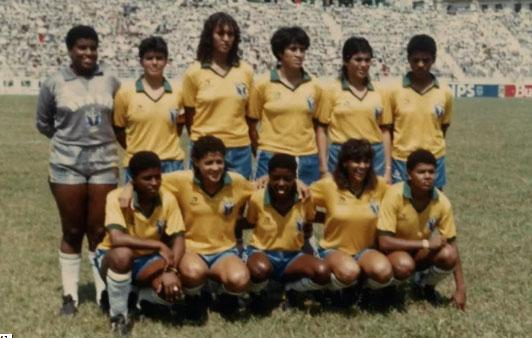
In 1983, Rio de Janeiro hosted its first women's football championship. It became the seed that gave rise to Brazil's first experimental women's national team, which represented the country in China in 1988. We returned home with a bronze medal.
For our group of pioneers, there were no role models to follow, no investment, no support system, and little belief that women's football had a future.
There was only rough talent, courage, and passion.
We pulled on football boots. We wore the leftover pieces of the men's national team uniforms. We represented Brazil because we loved the game and believed we belonged on the pitch.
Without structure, recognition, or compensation, we opened doors for the generation that would go on to represent Brazil at the first FIFA Women's World Cup in China in 1991.
Few people noticed.
The tournament was largely ignored by the Brazilian media. But at the time, very few people in Brazil—if anyone at all—realized that history was being written on those football fields.
When we came home, there were no crowds waiting at the airport. No parades. No interviews.
If we were lucky, our families were there.
The families who never turned away from the "strange girl" who insisted on stepping onto a field that so many believed was not meant for her.
Today, much has changed. We still fight for equality in football, in the workplace, and in society. We have not yet arrived where we want to be. But we are no longer where we once were.
For the athletes who represented Brazil in 1991, we became the role models: Marisa, Michael, Sissi, Roseli, Pelé, Cebola, and so many others. Invisible to the media of our time, we are now being rediscovered by new generations.
And before there was Marta. Before there was Formiga. Before women's football became a source of national pride. There were the pioneers.
That is why Brazil's Women's World Cup Legacy Law is so important. For the first time, the country officially recognizes something many of us learned on the pitch long ago: football can transform lives far beyond the four lines. It can create opportunity, develop leaders, challenge stereotypes, and help build a more equitable future for girls and women.
The law also includes something deeply symbolic: the official recognition of the pioneering generations of 1988 and 1991.
It is more than recognition.
It is historical justice.
For decades, our story remained largely invisible. Today, it is finally being brought into the light. And perhaps nowhere is that symbolism more powerful than in what happened this week.
One year before Brazil hosts the 2027 FIFA Women's World Cup, Christ the Redeemer will be illuminated in celebration of women's football.
For many people, it will be a beautiful image.
For those of us who spent years hearing that football was not a woman's game, it is something more. It feels like a spotlight finally shining on a chapter of history that Brazil took far too long to see.
I am part of that chapter.
Part of a generation that played with courage long before we had words to describe the strength that drove us. It was simply our love of football, our love of Brazil, and our love of life.
Today, that story has become pride, legacy, and belonging—everything that makes the beautiful game so powerful and perhaps one of the most unifying expressions of what it means to be Brazilian.
Back in 1988, we stepped onto the field carrying a ball, a dream, and a healthy dose of stubborn determination. We could never have imagined that one day there would be a Women's World Cup in Brazil, an illuminated Christ the Redeemer marking the one-year countdown, and millions of girls growing up without having to ask permission to play.
For someone who spent so many years hearing that football was not for women, it is a difficult scene to describe. Perhaps this is what people mean when they speak about legacy.
It is not a trophy. It is the moment a girl laces up her football boots for the first time and cannot even imagine that there was ever a time when someone told her she did not belong.
About the Author: Maria Pires Noguira is one of the pioneers of Brazilian women's soccer. A former defender and first captain in the history of the Brazilian Women's National Team, she represented Brazil in international competitions since 1988 and helped pave the way for the growth of women's soccer in the country.
Together We Can End Domestic and Sexual Violence


