The Activists Fighting for Legal Reform in the Middle East

Each day during NO MORE Week, we’re highlighting how communities around the world are taking action to end abuse. Today, join us on the KNOW MORE Blog and NO MORE’s social channels as we spotlight efforts across Africa and the Middle East.
In 2012, 16-year-old Amina al-Filali died by suicide after being forced into a marriage with the man who had raped her. The marriage was a result of a clause in Morocco’s Article 475, which stated: When a female minor of marriageable age thus abducted or corrupted has married her abductor, the latter can only be sued if the plaintiffs qualify to ask for the annulment of the marriage, and can only be condemned after the annulment has been pronounced. In short, a loophole existed which offered perpetrators a pathway to avoid accountability, on the pretext of restoring ‘honor’ to their victim.
Amina’s death prompted widespread grief and anger across Morocco, leading groups of activists, women’s rights organizations and community leaders to mobilize to demand change. Demonstrations began to unfold across the country, whilst media outlets examined the law and its consequences. The activism within Morocco quickly gained international attention.
In 2014, with a unanimous vote, Morocco removed the provision that had allowed rapists to evade prosecution through marriage. And it wouldn’t be the last to do so.
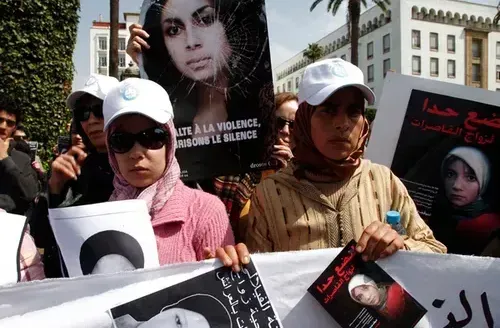
Morocco was not alone in having an article halting prosecution of perpetrators who married their victims. Similar provisions existed across the Levant, the Gulf and North Africa, often inherited from old legal codes dating back to French or Ottoman rule. However, once Morocco overturned the law, change began to ripple across the region. Activists organized to make it clear to their governments that the law was at odds with their country’s values and Islamic law, and that family ‘honor’ and reputation could not be prioritized above the lives and dignity of survivors.
Following the Moroccan victory, similar movements began to take shape in the Levantine countries of Jordan and Lebanon. King Abdullah II of Jordan had ordered a review of the country’s penal code, which dated all the way back to 1960. It included a similar article, which suspended criminal prosecution for rapists if they married their victims. Between 2010 and 2013, 159 perpetrators had used this provision to avoid punishment, according to the Jordanian Ministry of Justice. The Sisterhood is Global Institute, led by Asma Khader, combined grassroots organizing, legal research, survivor testimonies and lobbying to build a national coalition against the law. On August 1, 2017, parliament voted for a full repeal. Khader had been fighting to overturn it since the early 1980s.
In Lebanon, ABAAD, began their campaign #Undress522, in reference to Article 522 of the Lebanese Penal Code. For many years, the existence of this ‘marry-your-rapist’ loophole was not even known to the general public. ABAAD found in their research that only 1% of people were even aware of it.
So, they launched a national campaign to change that. #Undress522 was a loud and shocking campaign, ensuring lawmakers could not turn away. Activists took part in the Beirut Marathon dressed in white sheets with slogans calling for the abolishment of Article 522. As the Committee of Administration and Justice readied themselves to send the law abolishing 522 to parliament, ABAAD worked with the artist Mireille Honein to hand 31 white wedding dresses along the Corniche of Beirut. Each dress symbolized a day of the month where a woman or girl could be forced to marry their rapist, viscerally symbolizing the campaign slogan: “A white dress does not cover the rape”. The campaign was a success, Article 522 was overturned, and a little-known legal provision had been transformed into an urgent national issue.
These campaigns sent a clear message ripping across the region: marriage is not impunity. However, today, in 2026, there still remains a ways to go.
Last year, Equality Now published a comparative analysis of legal frameworks in all Arab League States, which showed that not one explicitly criminalized rape and sexual violence within marriage, a legal gap that persists in many parts of the world. This is despite many of the nations having abolished the ‘marry-your-rapist’ loophole. And in Iraq, Article 398 still allows a perpetrator to escape prosecution if he marries his victim. In fact, activists have criticised recent amendments to the country’s Ja’afari Personal Status code, which have led to husbands governing marriage, divorce, child guardianship care and inheritance, further weakening women’s legal standings and protections. Meanwhile, in Syria, conflict-related sexual violence has led to marriages between civilian women and fighters, illustrating the devastating way that the loophole can operate in practice.
Despite this, women’s rights organizations continue to push for change. The Baghdad Women Association has been active in campaigning against Article 398, and recently organized a project titled ‘Iraqi Women Changemakers’, which aims to educate nearly 150 women over the next year on advocating for women’s rights. Meanwhile, the Syrian Feminist Lobby is active in documenting violations of women’s rights and advocating for legal reform within the country.
The past two decades have demonstrated that discriminatory laws are not set in stone. When survivors, lawyers, artists, and activists build coalitions and sustain public pressure, even deeply entrenched legal norms can shift. But as long as marital rape remains decriminalized and legal escape routes persist, the fight for laws that recognize bodily autonomy, reject impunity, and place survivors at the center of the justice process is not yet over.
Learn more about how organizations and advocates are responding to gender-based violence throughout the Middle East on our NO MORE Week Regional Playlist on YouTube.
To seek help or find a support service near you, visit the NO MORE Global Directory.
Make a Donation
Your contribution creates a lasting global impact by helping us provide free resources, raise awareness, and drive change to end domestic and sexual violence.
Make a DonationTogether We Can End Domestic and Sexual Violence